

Book of Oberon: A Sourcebook on Goetic Magick
*Amazon links provided here are affiliate links, meaning that Goetic Impressions earns money from qualifying purchases made from them.
Table of contents
- What is the Book of Oberon?
- Johann Weyer
- The Office of Spirits
- The Princes of Hell
- The Cardinal Kings
- The Faeries
- Oberion - The Faerie King
- Mycob - The Faerie Queen
- TL;DR
- Court of Oberion - Enamel Pin Project
- References

What is the Book of Oberon?
Deep within the bowels of the Folger Shakespeare Library in Washington DC sits a curious book of magick from between 1577 and 1583. Officially listed as Manuscript V.b.26, it has been given the imaginative title of ‘The Book Of Oberon’ by Joseph Peterson when he published an edited version through Llewellyn in 2015. Whatever name the author or authors gave to the original manuscript has been lost, however this text serves as a strong link to an earlier tradition of ritual evocation magick with the aim of calling up demons for material gain.
Today most would be familiar with this style of magick from the Lesser Key of Solomon, or more modern systems for working with these spirits such as Demonolatry. The Book of Oberon displays strong ties to earlier traditions, with many of the original practices for evoking spirits lost to the modern practitioner (more on this in a bit.)
Unlike many other magickal texts this was a ‘working’ book of magick, meaning the contents were used by a practitioner who compiled and updated the material therein. This is useful because we know that the rituals were not purely theoretical, they were actually used by actual occult practitioners.
In addition to the normal cast of angels and demons, this book also contains extensive lists of faeries that can be called up and the various methods by which to do so. Faeries were very popular in England during the period this book was compiled, and you can find many references to spirits in this book in other works of popular art of the time. For instance the Faerie Mab (Mycob) in Romeo and Juliet, Titania (Titan) in A Midsummer Night’s Dream, and even the titular Oberon (Oberion/Oberyon) from the same play can all be traced to spirits listed within this text.
This book is divided into two parts: Theurgia and The Key of Solomon and includes lengthy invocations, spells, drawings, spirits, history, and a collection of talismans.

Johann Weyer![]()
So, before I go too much further it is important to mention Johann Weyer. Weyer was a student of Agrippa, and wrote a book known as the Pseudomonarchia Deamonium (1577), or: the False Hierarchy of Demons. This book was used as a reference for many of the texts on this style of magick that followed, including the source manuscripts Mathers used when compiling his Lesser Key of Solomon in 1903.
The problem is Johann Weyer intentionally omitted and changed information in his book in order to render it ‘unusable’ for those that would try to work with demons. This has led to the subsequent texts containing bad information, or missing information altogether, that earlier magicians considered integral when working with Goetic demons.
The Book of Oberon is particularly interesting because it appears right as the Pseudomonarchia Deamonium does, and by comparing the two we can get a solid sense of the information Weyer omitted and changed, and thus what has been missing from the practices of most Goetic magicians for the last 500 years.

The Office of Spirits
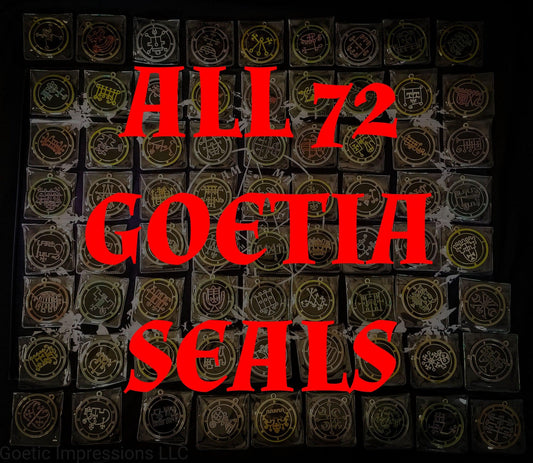
The official list of spirits in the Book of Oberon bears some resemblance to the list most will be familiar with from the Lesser Key of Solomon, however it is also quite different. It lists 82 spirits, which include the directional kings, rather than 72, with many names not appearing in Mathers list, and several of the names from the Lesser Key not appearing in the Book of Oberon. This is not unusual for historical spirit lists of Goetic entities, and in general working texts like this would list spirits that the magician themself had encountered or performed some work with. Sometimes as a result certain spirits would ultimately be unique to a single text, while others would appear over and over as multiple practitioners made use of a particular entity. Cross examining with other texts you’ll see similar descriptions of the spirits which can be linked to their origin. However, there are numerous spirits that have no ties to other texts, with unique appearances like elephants or even hedgehogs.

The Princes of Hell
The oldest forms of Goetic Evocation that we have records of are strictly hierarchical in nature, and call on one (or all) of the three Princes of Hell. Depending on what text you are using these are generally Lucifer, Beelzebub and either Astaroth, or Satan as the last. In some texts all three are subservient to Lucifer himself, and in those texts Astaroth or Satan is generally the third Prince.
In the book of Oberon specifically, Lucifer, Beelzebub and Satan are used. This is different from the Grimorium Verum and Grand Grimoire which uses Lucifer, Beelzebub and Astaroth. There is also mention Asmodai being the fourth but it is largely omitted from these texts.
In a Goetic evocation one would typically call upon one or all of these princes to grant the occultist the power to compel the spirit to appear, or else directly tell the spirit to appear themself. In this way it was not the human being who could call up the spirit, but Lucifer or Beelzebub themself who was compelling the spirit to appear on their behalf.

The Cardinal Kings
Additionally Weyer altered the Cardinal Kings, or the Demon Kings of the four directions in his book. These appear in the Book of Oberon, with Orience in the East, Paymon in the West Amaymon in the South and Egin in the North . Similar to the Princes, one would call upon the king of the directional ruler of the spirit one was evoking in order to obtain permission and compel the spirit to appear. Prior to Weyer this was a foundational element of a successful evocation, with the historical texts largely agreeing on which king ruled which direction.
After Weyer the spirits were shuffled around, omitted or changed, and the Book of Oberon represents one of the last works within the tradition representative of the ‘original’ attributions. (It is worth noting that many texts spell the spirits names differently, and here and there some texts deviate from the four primary spirits listed and the directions they were assigned to, however the listing in the Book of Oberon is the most widely used template prior to 1577, minor differences aside.)
Under each directional King is a list of 12 spirits that are subservient to them. While it is not a complete list that would match the 72 in the Ars Goetia, it does help sort missing pieces for the directional correspondences within the Goetia.
Most notably Paymon (Paimon) is considered a directional King of the West instead of just a numbered spirit in the Ars Goetia. In Paimon’s description it is stated that he is obedient to Lucifer, which is the first time that Lucifer is mentioned in the Lesser Key of Solomon.
Belial is also one of the goetic kings under the rule of Paimon which would align him with the West. This was omitted in the Lesser Key. In the LKoS, Belial also has a mashed up description that after careful examination is similar to Bell/Bellsabube (Beelzebuth) in the first section of Oberon, specifically noting him to be directly after Lucifer.
The differences in the descriptions of the spirits between texts is worth considering when working with these spirits, as depending on which texts you are utilizing you may be calling a spirit who is not ideally suited for the task. Because of this it is worth verifying for yourself via ritual whether the spirit can complete the task you are asking them to, and is a good match for future workings with a similar goal. No amount of historical precedent will replace the tried and true method of recording your own results and using those to inform your practice.

The Faeries
Very little has been published in places accessible to the modern practitioner on working with Faeries in ritual, however this was a very common category of spirit for occultists to work with, especially in England. The Book of Oberon is fairly unique (pun intended) in this respect, and quite a bit of material is devoted to working with the various faeries to obtain the ring of invisibility (which may have later influenced one J.R.R. Tolkien, a scholar of the history of mythology and someone who likely would have been aware of this text), as well as rituals by which one may call upon the Faerie King Oberion (from which ‘Oberon’ is derived).
Many of these Faeries have attributes similar to those typically assigned to Goetic spirits, i.e. the ability to bestow great wealth or treasure on those working with them. All of these Faeries are known for nature magick such as giving the knowledge of herbs, stones, trees and medicine.

Oberion/Oberyon - The Faerie King
Oberion is one of the spirits in this book that stands out the most. While he is listed last in the Office of Spirits, there is a wealth of information on him including a long detailed description, drawings, diagrams, sigils and an entire ritual devoted on how to summon him.
Oberion in this text is known as the Faerie King, while his route origin is linked to the name Alberich meaning Elf Ruler, he is also depicted as a dwarf. Dwarves, elves, and pygmies are all associated with the Faerie kingdom, dating back to the Middle High German period centuries before this manuscript was written.
He usually appears as a young boy (which may be misattributed to dwarf being short in stature) wearing a crowned turban. In addition to the nature magick previously mentioned by faeries, he also has knowledge of all metals and is most commonly called to bring treasure out of the sea.
Oberion is under the powers of the Sun and Moon and like most goetic spirits is versed in divination.
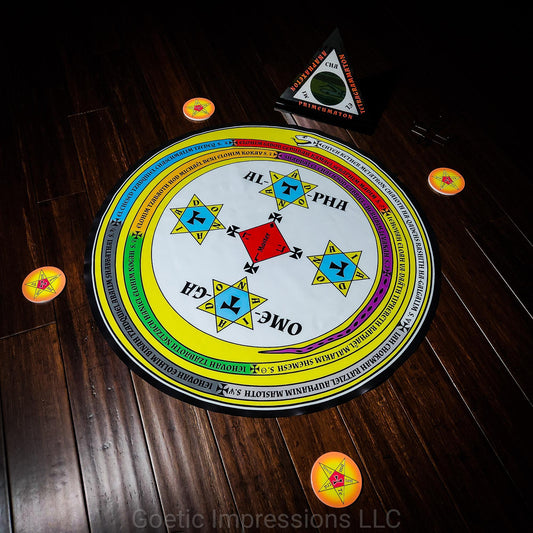
In the Book of Oberon there are several drawings depicting Oberion. He usually wears a type of scalemail, with a sword and wearing a crown over a turban. There is one where he is in a form of an aetherial spirit. Each of these are surrounded by additional sigils denoting his followers and how to conjure him. Additionally, there is a fairly lengthy invocation with additional steps in case he is stubborn and fails to initially appear. The text also contains a dedicated circle used to evoke him.

Mycob - The Queen of Faeries (Pygmies)
Mycob is listed directly after the full list of the office of spirits. While she is not part of the 82 listed spirits, it is noted that she is of the same office as Oberion. She appears in green with a crown and is very meek and gentle in nature. She is one of the primary faeries to give the ring of invisibility to the invoker. Under her are seven faerie sisters that share similar magicks to her:
- Lillia
- Restillia
- Fata
- Falla
- Afria
- Julya
- Venalla
In one ritual, the invoker is stated to also call upon Titan in aid to acquire the ring of invisibility.
Sibilis or Sibillia, known as the empress of fae, is also mentioned with the faeries.
The Faerie sisters and Oberion are the only ones with sigils in this manuscript out of the mentioned fae above. Oberon is shown to have several different sigils, which were most likely compiled from other sources.

TL;DR
The Book of Oberon provides a ‘missing link’ between more modern texts derived from the intentional misrepresentation of Goetic magick by Johann Weyer, and earlier works informed by a living tradition of practicing magicians. It is valuable for any student of magick, but especially those looking to instill an element of historical authenticity into their ritual practice.
We recommend this book as a supplemental source reference to goetic magick that can empower your workings with the goetia even further.

Court of Oberion - An Enamel Pin Collection
Inspired by this text and wanting to pay homage to the faeries in this book, we had the opportunity to join other artists in an event centered around Folklore and Fairytales as part of Pin Quest on Backerkit in which we designed stylized pins. First is Oberion with the Sun and the Moon, followed by Mycob and her Faerie Sisters. If all the faeries are unlocked, they will reveal the ring of invisibility!
As an additional bonus to this campaign, we’ll even be revealing something that practitioners will be eager to get their hands on. :)
Supporters of our campaign will have the chance to earn freebies and discounted merch before going live in our shop. Consider it a bonus to super-early pre-order perks!
Can you help unlock the full Court of Oberion?
Main Sources and References
The Book of Oberon by Joseph H Peterson
We do not use generative AI in any of our work, we take the time to read, research, cross reference and check our findings. This also goes for our artwork and designs as we feel it would strip the magick from them.